The first 16 weeks of a Golden Retriever puppy's life are the most important training window you will ever have. What you do — and what you fail to do — during this period shapes the dog's behavior for years. Dallas, Acworth, and Kennesaw see more Golden Retrievers than almost any other breed, and we work with Golden owners from all three communities regularly. The most common thread in every adult Golden Retriever problem we are called in to fix: an owner who thought things would "sort themselves out" during the puppy stage. They do not sort themselves out. They solidify. This guide gives Dallas, Acworth, and Kennesaw Golden Retriever owners a concrete, week-by-week framework for the first four months — and tells you exactly what skills to build and when.
Weeks 8–10: The Arrival Window — What to Do in the First Two Weeks
The moment your Golden Retriever puppy arrives in your Dallas or Kennesaw home, training begins — whether you intend it to or not. Every interaction teaches the puppy what to expect from humans and what behaviors get results. In the first two weeks, focus on three things exclusively: crate introduction, name recognition, and basic household rules. The crate should be introduced the first night — not after the puppy has spent two weeks sleeping in the bed or on the couch. Meals should be fed inside the crate with the door open initially, then closed for increasing durations. Name recognition is built with simple repetition: say the puppy's name in a happy tone, reward with food or praise when they look at you. Household rules mean deciding immediately and communicating to every family member: is the dog allowed on furniture or not? Is jumping on people allowed during greetings? Rules established in week one are dramatically easier to maintain than rules introduced at month three.
Weeks 10–12: The Foundation Commands — Sit, Down, and Name Response
Between 10 and 12 weeks, your Golden Retriever puppy has the cognitive capacity to begin learning formal commands, and the food motivation to make it easy. Begin with sit using lure-and-reward: hold a treat above the puppy's nose and move it back over the head — the hindquarters drop naturally. Mark the moment the sit occurs with a clear verbal marker ("yes") and deliver the treat. Repeat in short 3-to-5-minute sessions, multiple times daily. Down follows the same lure mechanics: from a sit, lower the treat to the floor between the paws. Both commands should reach reliable performance — at least 8 out of 10 correct responses on the first cue — before you move on. Name response should be tested in mild distraction by the end of week 12: call the puppy's name from across the room with a toy visible nearby and expect a reliable look toward you. If you cannot get reliable attention at close range, do not begin leash work yet.
"Puppies trained during the 8–16 week socialization window retain command reliability at significantly higher rates than dogs who begin formal training after 6 months of age"
— Veterinary Record: Canine Cognitive Development and Early Training Outcomes
Weeks 12–14: Leash Introduction and the Start of Loose-Leash Walking
For Acworth and Kennesaw puppy owners who plan to walk their Golden on neighborhood trails and streets, leash work needs to start now — not at six months when the puppy weighs 45 pounds and has already learned that pulling gets them where they want to go. Introduce the leash indoors first: clip it on and let the puppy drag it for short supervised periods before you ever apply pressure. Begin leash pressure work in the backyard with minimal distraction: apply gentle forward pressure, wait for the puppy to take one step toward you, mark and reward immediately. The goal at 12 to 14 weeks is not a perfect heel — it is a puppy that understands leash pressure means move toward the handler, not pull away. Practice daily in low-distraction environments before moving to sidewalks or Dallas neighborhood streets.
Weeks 14–16: Stay, Recall, and the "Place" Command
By 14 weeks, your Golden Retriever puppy has enough focus and impulse control to begin stay duration work. Start with sit-stay: ask for a sit, take one step back, return immediately and reward before the puppy breaks. Build duration in one-second increments — there is no shortcut. A stay that breaks every time you move has not been trained to fluency; it has been practiced inconsistently. Recall work at 14 weeks uses the long line: attach a 15-foot line in the backyard, move away, then call the puppy in a high-value, excited tone. Every recall must be rewarded generously — never call your puppy and follow it with something they dislike (nail trimming, crating against their will, bath time). The place command — sending the puppy to a specific mat and holding position — should be introduced by week 16. Dallas and Kennesaw families with active households will find this command transforms the puppy's behavior during mealtimes, guest arrivals, and high-traffic household moments.
Socialization in the Dallas, Acworth, and Kennesaw Area: Specific Venues
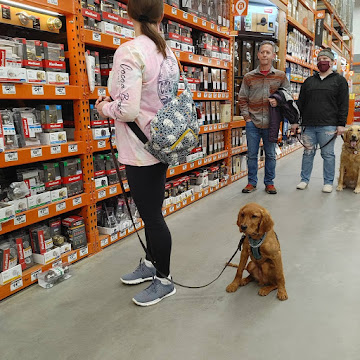
Socialization is time-sensitive — the critical window closes around 16 weeks. Dallas, Acworth, and Kennesaw offer specific venues that work well for puppy socialization before the vaccination series is complete. Home Depot and Lowe's locations in Kennesaw and Acworth welcome leashed dogs and provide exposure to carts, forklifts, loud noises, and strangers of all types. The outdoor areas of the Kennesaw Mountain trailhead parking lot offer people, other dogs at a distance, and nature sounds. Paulding County's rural areas near Dallas offer farm animals, tractors, and open environments. The goal is not overwhelming the puppy — it is calm, positive exposure to as many stimuli as possible. If the puppy shows fear (tucked tail, cowering, trying to flee), increase distance from the stimulus and slow down. Forced exposure to things that frighten a puppy during this window creates lasting fear associations, not confidence.
The Mouthing Protocol: Handling Puppy Biting in Weeks 8–16
Golden Retriever puppies bite. All of them. Families in Dallas and Kennesaw with young children need a clear, consistent mouthing protocol that every household member follows without exception. The rule is simple: the moment teeth touch skin, all play stops immediately. Stand up, turn your back, remove attention completely for 20 to 30 seconds. Then re-engage calmly. The puppy learns that teeth on skin ends the game it wants to play. Simultaneously, provide appropriate outlets: frozen Kongs, bully sticks, and rope toys teach the puppy that putting its mouth on objects is acceptable and satisfying. Do not use your hands or feet as play objects with a mouthing puppy — every hand-play session teaches the puppy that human skin is a valid chew target. Children must be coached specifically: squealing, running, and waving hands in a mouthy puppy's face is prey behavior that dramatically increases biting intensity.
What Happens If You Miss the Window: Training Older Goldens in North Georgia
Not every Golden Retriever owner in the Dallas, Acworth, or Kennesaw area is starting with a puppy. Many are working with adolescent or adult Goldens who missed early structure. The good news: Golden Retrievers remain highly trainable well into adulthood, and their food motivation and people-orientation make them excellent candidates for rehabilitation work. The process takes longer and requires more systematic deconditioning of established habits, but the breed's fundamental nature works in the owner's favor. An 18-month-old Golden with jumping, pulling, and mouthing issues that have been allowed to solidify is a 6-to-8-week project under structured professional guidance — not a lost cause. If you have a rescue Golden or an adolescent who never received training, the time to start is right now, not after the behavior gets worse.
"Adult dogs with no prior training history can achieve functional obedience reliability within 6–8 weeks when trained with consistent daily sessions — breed motivation is a stronger predictor of outcome than age at training onset"
— Journal of Veterinary Behavior: Adult Dog Training Outcomes
Common Mistakes Dallas, Acworth, and Kennesaw Golden Retriever Owners Make
Across the three communities we most frequently serve, the same patterns appear in Golden Retriever cases. First: treating the puppy like a stuffed animal for the first two months and introducing rules at month three — by which point the puppy has already learned what it can get away with. Second: using verbal warnings without consequences — "no, no, no" with no follow-through teaches the puppy that warnings are noise. Third: inconsistent rules between family members, which teaches the puppy to test every human separately. Fourth: skipping the crate and allowing full house access too early, which produces a dog that cannot self-settle and damages property when left alone. Fifth: relying on the Golden's friendliness as a substitute for trained behavior — a friendly dog that jumps on, pulls toward, and mouths every person it meets is not a well-behaved dog; it is an enthusiastic liability.
The Bottom Line
The Golden Retriever puppy you raise in the first 16 weeks is the adult dog you live with for the next 10 to 12 years. That window is short and it does not come back. Dallas, Acworth, and Kennesaw Golden Retriever owners who invest in structured training early are the owners who call us years later to say their dog is the easiest animal they have ever lived with. The owners who skip it are the ones calling us at 18 months with a 70-pound dog that has never been told no. Next Generation Dog Training serves the entire Dallas, Acworth, and Kennesaw area — reach out for a free consultation and let's build your Golden right from the start.
Book a Free ConsultationSources & Citations
- [1]AKC: Golden Retriever Breed Information and History
- [2]Veterinary Record: Early Training and Long-Term Behavior Outcomes
- [3]Journal of Veterinary Behavior: Adult Dog Training Outcomes
- [4]American Veterinary Society of Animal Behavior: Puppy Socialization Guidelines
- [5]American Veterinary Medical Association: Responsible Pet Ownership